¶ dx:resultType
The type dx:resultType contains the result of measurement, evaluation or information on calibration. The entries in this area are such that a value is always linked to a unit. SI units should always be used.
¶ Tree structure
The tree structure of the element dx:resultType has the following appearance:
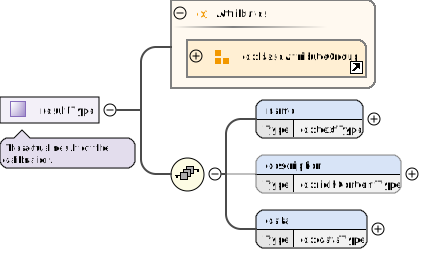
¶ Snippet from the XML schema: type definition "resultType"
    <xs:complexType name="resultType">
        <xs:annotation>
            <xs:documentation>
                The actual result of the calibration.
            </xs:documentation>
        </xs:annotation>
        <xs:sequence>
            <xs:element name="name" type="dx:textType"/>
            <xs:element name="description" type="dx:richContentType" minOccurs="0"/>
            <xs:element name="data" type="dx:dataType"/>
        </xs:sequence>
        <xs:attributeGroup ref="dx:baseAttributeGroup"/>
    </xs:complexType>
¶ Description of the elements
See the list of abbreviations here
| Element (Element type) |
Use | Description |
|---|---|---|
| dx:name (dx:textType) |
[M] | The name of the calibration item is specified in this element. |
| dx:description (dx:richContentType) |
[O] | Other information that is not given in the dx:name elements is given here to describe the element. |
| dx:data (dx:dataType) |
[M] | In this element further data for calibration can be entered. |
¶ Attributes
| Attribute | Use | Description |
|---|---|---|
| dx:baseAttributeGroup | [O] | An attribute group called "baseAttributeGroup" is referenced here. This attribute group contains a set of attributes that are commonly used in elements of the DX. An attribute group is a reusable collection of attributes. |