¶ dx:coreDataType
The type dx:coreDataType is used to give the information for core data of a certificate or report.
¶ Tree structure
The tree structure of the dx:coreDataType has the following appearance:
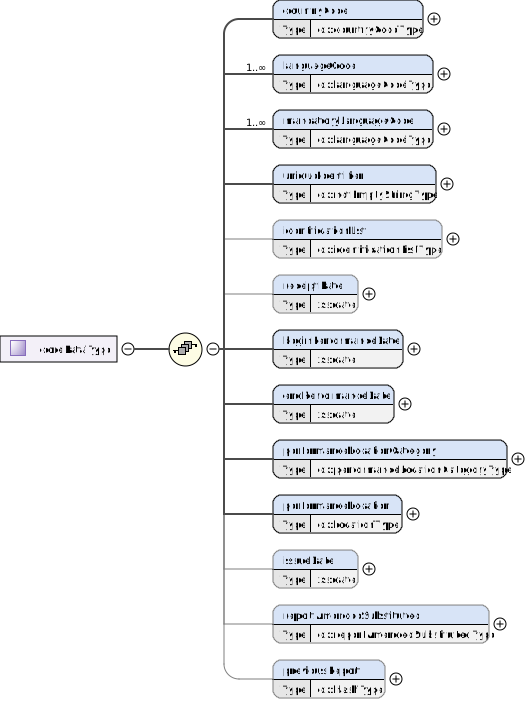
¶ Snippet from the XML schema: definition "statementMetaDataGroup"
    <xs:complexType name="coreDataType">
        <xs:sequence>
            <xs:element name="countryCode" type="dx:countryCodeType"/>
            <xs:element name="languageCode" type="dx:languageCodeType" maxOccurs="unbounded"/>
            <xs:element name="mandatoryLanguageCode" type="dx:languageCodeType" maxOccurs="unbounded"/>
            <xs:element name="uniqueIdentifier" type="dx:notEmptyStringType"/>
            <xs:element name="identificationList" type="dx:identificationListType" minOccurs="0"/>
            <xs:element name="receiptDate" type="xs:date" minOccurs="0"/>
            <xs:element name="beginPerformanceDate" type="xs:date"/>
            <xs:element name="endPerformanceDate" type="xs:date"/>
            <xs:element name="performanceLocationCategory" type="dx:performanceLocationCategoryType"/>
            <xs:element name="performanceLocation" type="dx:locationType"/>
            <xs:element name="issueDate" type="xs:date" minOccurs="0"/>
            <xs:element name="reportAmendedSubstituted" type="dx:reportAmendedSubstitutedType" minOccurs="0"/>
            <xs:element name="previousReport" type="dx:hashType" minOccurs="0"/>
        </xs:sequence>
    </xs:complexType>
¶ Description of the elements
See the list of abbreviations here
| Element (Element type) |
Use | Description |
|---|---|---|
| dx:countryCode (dx:countryCodeType) |
[M] | In which country was the calibration performed? The information is given in the country code specified in ISO 3166 (two capital letters). |
| dx:languageCode (dx:languageCodeType) |
[M] | Indication of the official language(s) in which the certificate or reprot was created. The specification is made in the code for the official languages defined in ISO 639 (two lower case letters). |
| dx:mandatoryLanguageCode (dx:languageCodeType) |
[M] | Determination of the official language(s) valid in case of doubt. The specification shall be made in the code for official languages (two lower case letters) specified in ISO 639. |
| dx:uniqueIdentifier (dx:notEmptyStringType) |
[M] | A worldwide unique identifier for the certificate or report shall be specified here. A necessary condition is that the identifier is unique in the organisation where the calibration laboratory is located. |
| dx:identificationList (dx:identificationListType) |
[O] | Identifications in dx:coreDate contains further identifiers which describe exactly this certificate or report. The item also contains an element Identification, which describes the object exactly. |
| dx:receiptDate (xs:date) |
[M|O] | Date of receipt of the calibration item. The date shall be given if it has a temporal influence on the calibration result. |
| dx:beginPerformanceDate (xs:date) |
[M] | Date at the start of the performance of the laboratory activity. |
| dx:endPerformanceDate (xs:date) |
[M] | Date at the end of the performance of the laboratory activity. |
| dx:performanceLocationCategory (dx:performanceLocationCategoryType) |
[M] | This element specifies the category of the performance location. The choices are "laboratory", "customer", "laboratoryBranch", "customerBranch" and "other". Where Laboratory and Customer refer to the respective postal address. |
| dx:performanceLocation (dx:locationType) |
[M] | This element specifies the location of the performance. |
| dx:issueDate (xs:date) |
[O] | Due to the decision that the issuing of the certificate or report must be possible without a signature. |
| dx:reportAmendedSubstituted (dx:reportAmendedSubstitutedType) |
[O] | With this element it is possible to specify whether the certiricate or report is amending or substituting a previous one. |
| dx:previousReport (dx:hashType) |
[O] | The element dx:previousReport gives the possibility to refer to the previous certificate or report which was replaced by this one. |