¶ dx:statementMetaDataGroup
The group dx:statementMetaDataGroup defines a group of elements to be used in metadata and statements on calibration.
¶ Tree structure
The tree structure of the dx:statementMetaDataGroup has the following appearance:
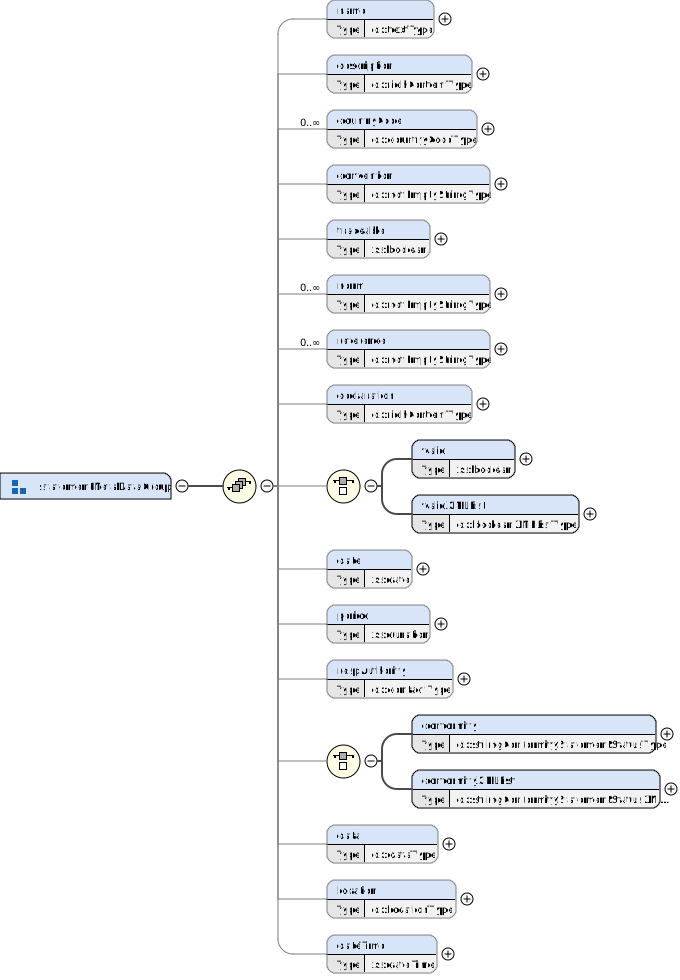
¶ Snippet from the XML schema: definition "statementMetaDataGroup"
    <xs:group name="statementMetaDataGroup">
        <xs:sequence>
            <xs:element name="name" type="dx:textType" minOccurs="0"/>
            <xs:element name="description" type="dx:richContentType" minOccurs="0"/>
            <xs:element name="countryCode" type="dx:countryCodeType" minOccurs="0" maxOccurs="unbounded"/>
            <xs:element name="convention" type="dx:notEmptyStringType" minOccurs="0"/>
            <xs:element name="traceable" type="xs:boolean" minOccurs="0"/>
            <xs:element name="norm" type="dx:notEmptyStringType" minOccurs="0" maxOccurs="unbounded"/>
            <xs:element name="reference" type="dx:notEmptyStringType" minOccurs="0" maxOccurs="unbounded"/>
            <xs:element name="declaration" type="dx:richContentType" minOccurs="0"/>
            <xs:choice minOccurs="0">
                <xs:element name="valid" type="xs:boolean"/>
                <xs:element name="validXMLList" type="dx:booleanXMLListType"/>
            </xs:choice>
            <xs:element name="date" type="xs:date" minOccurs="0"/>
            <xs:element name="period" type="xs:duration" minOccurs="0"/>
            <xs:element name="respAuthority" type="dx:contactType" minOccurs="0"/>
            <xs:choice minOccurs="0">
                <xs:element name="conformity" type="dx:stringConformityStatementStatusType"/>
                <xs:element name="conformityXMLList" type="dx:stringConformityStatementStatusXMLListType"/>
            </xs:choice>
            <xs:element name="data" type="dx:dataType" minOccurs="0"/>
            <xs:element name="location" type="dx:locationType" minOccurs="0"/>
            <xs:element name="dateTime" type="xs:dateTime" minOccurs="0"/>
        </xs:sequence>
    </xs:group>
¶ Description of the elements
See the list of abbreviations here
| Element (Element type) |
Use | Description |
|---|---|---|
| dx:name (dx:textType) |
[O] | This element specifies the name of the statement. |
| dx:description (dx:richContentType) |
[O] | Other information not given in the element dx:name is given here in order to describe the statement. |
| dx:countryCode (dx:countryCodeType) |
[O] | The abbreviation of the official language is entered in this element. Here the country code is given [^1]. |
| dx:convention (dx:notEmptyStringType) |
[O] | The String data type represents strings in XML. |
| dx:traceable (xs:boolean) |
[O] | Indicates whether the measurement result is traceable [^2]. Boolean has the value space required to support the mathematical concept of binary-valued logic: {true, false}. |
| dx:norm (dx:notEmptyStringType) |
[O] | Reference is made here to the standards and guidelines that were taken into account in the measurement |
| dx:reference (dx:notEmptyStringType) |
[O] | The String data type represents strings in XML. |
| dx:declaration (dx:richContentType) |
[O] | Text as well as images and formulas can be stored in this element. |
| dx:valid (xs:boolean) |
[O] | Indicates that the result is in valid range. |
| dx:validXMLList (dx:booleanXMLListType) |
[O] | This element is used to specify foot notes for si:realListXMLList. |
| dx:date (xs:date) |
[O] | Fill in a valid date. |
| dx:period (xs:duration) |
[O] | DIN ISO 8601-1:2020-12 Date and time - Presentation for the exchange of information - Part 1: Basic rules (ISO 8601-1:2019) doi: 10.31030/3178552[^3] |
| dx:respAuthority (dx:contactType) |
[O] | Information about a responsible authority, in regards to the statement it is defined in, can be specified here by contact information. |
| dx:conformity (dx:stringConformityStatementStatusType) |
[O] | Used to enter compliance statements. |
| dx:conformityXMLList (dx:stringConformityStatementStatusXMLListType) |
[O] | Used to enter compliance statements in an XMLList. |
| dx:data (dx:dataType) |
[O] | With the help of the element type dx:dataType different data formats are made known. |
| dx:location (dx:locationType) |
[O] | An additional location can be described here. |
| dx:dateTime (xs:dateTime) |
[O] | Fill in a valid date Time. |