¶ dx:positionCoordinatesType
The type dx:positionCoordinatesType is used to enter location coordinates in any form of representation[1] . With it, it is possible to specify coordinates of administrative maps (parcels and their names), coordinates on the world's oceans or even on other planets.
¶ Tree structure
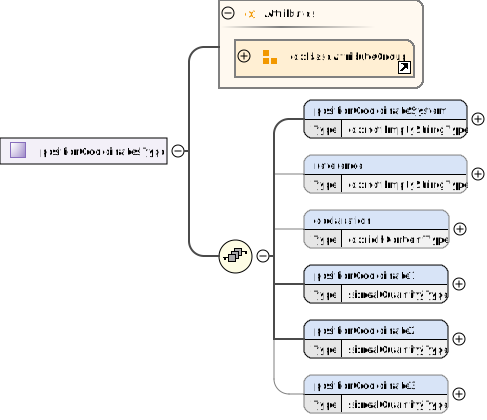
The tree structure of the type dx:positionCoordinatesType has the following appearance:
¶ Snippet from the XML schema: type definition "positionCoordinatesType"
    <xs:complexType name="positionCoordinatesType">
        <xs:sequence>
            <xs:element name="positionCoordinateSystem" type="dx:notEmptyStringType"/>
            <xs:element name="reference" type="dx:notEmptyStringType" minOccurs="0"/>
            <xs:element name="declaration" type="dx:richContentType" minOccurs="0"/>
            <xs:element name="positionCoordinate1" type="si:realQuantityType"/>
            <xs:element name="positionCoordinate2" type="si:realQuantityType"/>
            <xs:element name="positionCoordinate3" type="si:realQuantityType" minOccurs="0"/>
        </xs:sequence>
        <xs:attributeGroup ref="dx:baseAttributeGroup"/>
    </xs:complexType>
¶ Description of the elements
See the list of abbreviations here
| Element (Element type) |
Use | Description |
|---|---|---|
| dx:positionCoordinateSystem (dx:notEmptyStringType) |
[M] | The system which was used to determine the position coordinates. |
| dx:reference (dx:notEmptyStringType) |
[O] | Reference |
| dx:declaration (dx:richContentType) |
[O] | Declaration of the position coordinates. |
| dx:positionCoordinate1 (si:realQuantityType) |
[M] | First dimension of position coordinates. |
| dx:positionCoordinate2 (si:realQuantityType) |
[M] | Second dimension of position coordinates. |
| dx:positionCoordinate3 (si:realQuantityType) |
[O] | Third dimension of position coordinates. (Not needed with 2D coordinates) |
¶ Attributes
| Attribute | Use | Description |
|---|---|---|
| dx:baseAttributeGroup | [O] | An attribute group called "baseAttributeGroup" is referenced here. This attribute group contains a set of attributes that are commonly used in elements of the DX. An attribute group is a reusable collection of attributes. |