¶ dcr:target
In the target element, all information about the request’s target is provided. For example, it specifies whether the target is a calibration, a verification, or something else. It should also contain the target points and a list of items required for the result.
¶ Tree structure
The tree structure of the element dcr:target has the following appearance:
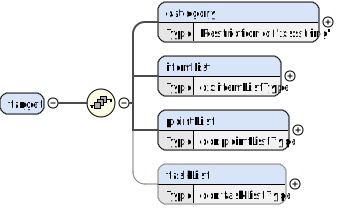
¶ Extract from the XML schema: Element definition "dcr:target"
...
<xs:element name="target">
    <xs:complexType>
        <xs:sequence>
            <xs:element name="category">
                <xs:simpleType>
                    <xs:restriction base="xs:string">
                        <xs:enumeration value="calibration"/>
                        <xs:enumeration value="verification"/>
                        <xs:enumeration value="test"/>
                    </xs:restriction>
                </xs:simpleType>
            </xs:element>
            <xs:element name="itemList" type="dx:itemListType"/>
            <xs:element name="pointList"
                type="dcr:pointListType"/>
            <xs:element name="taskList" type="dcr:taskListType" minOccurs="0"/>
        </xs:sequence>
    </xs:complexType>
</xs:element>
...
¶ Description of the elements
See the list of abbreviations here
| Element Element type |
Use | Description |
|---|---|---|
| dcr:category (Restriction of xs:string) |
[O] | Enumeration indicating the measurement category of the target. Possible values are: calibration, verification, test. |
| dcr:itemList (dx:itemListType) |
[M] | Unique identification, description and, if applicable, condition of the calibration item. |
| dcr:pointList (dcr:pointListType) |
[O] | A list of points as targets for the measurement means that the customer wants the measurement to be performed for the specific points. |
| dcr:taskList (dcr:taskListType) |
[O] | A list of tasks the customer wants be done by the laboratory or service provider in general. |